- +91 7381040775 / +91 7381030775
- support@drdiptimanent.com
- Monday - Sunday : 10AM- 4PM
- Monday - Friday : 6PM-8PM
- JCEM Diagnostics, Tarini Lane, Near Secondary Board High School, Bajrakabati Rd, Cuttack, Odisha – 753001
Salivary glands help produce the saliva needed for digestion, swallowing, and keeping the mouth comfortable. However, problems such as salivary stones, duct narrowing, or repeated inflammation can block the normal flow of saliva.
When this happens, patients may develop swelling and pain, especially while eating.
In the past, some patients with persistent salivary gland problems needed surgery to remove the affected gland. Today, sialendoscopy offers a less invasive way to diagnose and treat many salivary duct problems while preserving the gland.
So, how does sialendoscopy compare with traditional salivary gland surgery? Understanding the differences can help patients discuss the most suitable treatment with their ENT specialist.
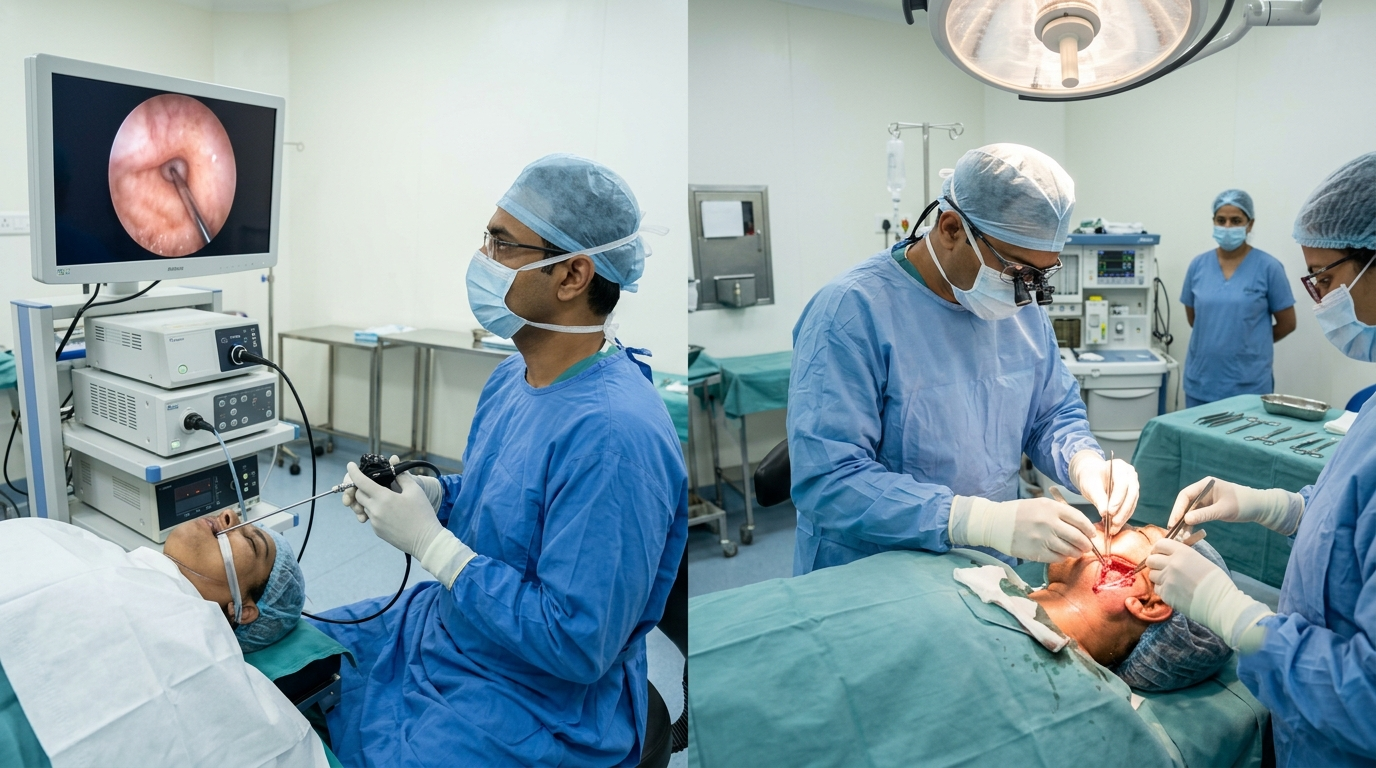
Sialendoscopy is a minimally invasive procedure used to examine and treat the ducts of the major salivary glands.
A very small endoscope is passed through the natural opening of the salivary duct inside the mouth. This allows the doctor to see the inside of the duct and identify problems such as:
Depending on the problem, special instruments can also be used through the endoscope to remove stones or treat the blockage.
Traditional surgery may involve making an external incision and removing part or all of the affected salivary gland.
For example, submandibular gland excision may be considered when a salivary stone or repeated inflammation cannot be successfully treated with less invasive methods.
Unlike sialendoscopy, the goal of gland excision is to remove the affected gland rather than simply treat the obstruction inside its duct.
Salivary stones, also called sialoliths, can block the flow of saliva.
When the duct is blocked, saliva may build up behind the stone. As a result, patients can experience:
If the blockage continues, treatment may be needed to restore normal saliva flow.
The biggest difference is gland preservation.
With sialendoscopy, the doctor attempts to treat the problem while keeping the salivary gland intact.
Traditional gland surgery, on the other hand, removes the affected gland when necessary.
Therefore, sialendoscopy can be an attractive option when the blockage can be safely reached and treated through the salivary duct.
During sialendoscopy, the doctor identifies the opening of the salivary duct inside the mouth.
A small endoscope is then carefully introduced into the duct.
The doctor can view the duct on a screen and locate the obstruction.
If a stone is suitable for endoscopic removal, specialized instruments may be used to retrieve it. In some cases, techniques such as fragmentation or a combined surgical approach may be needed.
The exact method depends on the stone’s size, location, shape, and the condition of the duct.
Traditional surgery usually involves an incision to access and remove the affected salivary gland.
For example, submandibular gland removal may be considered when obstruction or inflammation continues despite less invasive treatment.
Although effective, gland removal is a more extensive procedure than simply treating a blockage inside the duct.
One of the main advantages of sialendoscopy is that it aims to preserve the salivary gland.
Other potential benefits include:
Studies have generally found sialendoscopy to be effective for obstructive salivary gland diseases, although success varies depending on the condition and the patient’s anatomy.
Traditional surgery remains an important treatment option.
It can be particularly useful when:
Therefore, traditional surgery has not become obsolete. Instead, it is often reserved for cases where gland-preserving approaches are unlikely to provide a satisfactory result.
No.
Although sialendoscopy has a high success rate for many obstructive salivary gland problems, it does not work for every patient.
The result can depend on factors such as:
A large or deeply located stone may require a combined approach or traditional surgery.
In a large systematic review, success varied across different conditions, with better results generally seen for salivary stones than for some other forms of obstruction.
Yes.
This is one of its most important advantages.
Instead of removing the entire gland, sialendoscopy aims to remove the obstruction and allow saliva to flow normally again.
Earlier studies and systematic reviews have reported high rates of gland preservation with sialendoscopic treatment of obstructive salivary gland disease.
It can be.
Large, deeply located, or difficult-to-reach stones may not be suitable for sialendoscopy alone.
In such cases, doctors may use a combined approach, where sialendoscopy is used along with another surgical technique.
Therefore, the choice is not always simply “sialendoscopy or surgery.” Sometimes combining techniques provides the best chance of removing the obstruction while still preserving the gland.
Recovery depends on the specific procedure, the location of the obstruction, and the patient’s overall condition.
Because sialendoscopy is minimally invasive, recovery may be easier for suitable patients compared with gland removal.
Traditional surgery involves a larger surgical procedure and therefore may require more postoperative care.
Your ENT specialist can explain the expected recovery period based on the exact procedure recommended for you.
Like any medical procedure, sialendoscopy has potential risks.
These can include:
However, published studies generally report a low rate of major complications. At the same time, the available research has limitations, so individual outcomes can vary.
Traditional surgery is effective but involves a larger operation.
Depending on the gland being treated, possible complications may include:
The specific risks depend on which salivary gland is being removed and the complexity of the surgery.
Sialendoscopy is mainly used for obstructive salivary gland diseases.
These may include:
It can be used for problems affecting major salivary glands, including the submandibular and parotid glands.
| Feature | Sialendoscopy | Traditional Surgery |
|---|---|---|
| Approach | Minimally invasive | More extensive surgery |
| Main goal | Treat the duct blockage | Remove affected gland when necessary |
| Salivary gland | Usually preserved | May be removed |
| External incision | Often not required | Usually required for gland removal |
| Best suited for | Many duct blockages and suitable stones | Complex or unsuitable cases |
| Recovery | Often less invasive | May require longer recovery |
| Large or difficult stones | May require combined treatment | Can be effective |
| Major complications | Generally uncommon | Depends on surgery and anatomy |
There is no single treatment that is best for every patient.
For suitable salivary stones and duct obstructions, sialendoscopy is often preferred because it can treat the blockage while preserving the salivary gland.
However, traditional surgery may still be the better option when the obstruction is difficult to access, the gland is severely affected, or minimally invasive treatment has failed.
Therefore, the decision should be based on the patient’s symptoms, imaging results, stone size and location, and overall gland condition.
You should consider an ENT evaluation if you experience:
Early evaluation can help identify the cause and determine whether conservative treatment, sialendoscopy, a combined procedure, or traditional surgery is appropriate.
Sialendoscopy has changed the treatment of many obstructive salivary gland problems by allowing doctors to diagnose and treat duct problems while preserving the gland.
For suitable patients, it can reduce the need for complete gland removal.
However, it is not suitable for every case. Large or difficult stones, severe gland damage, and failed minimally invasive treatment may require a combined approach or traditional surgery.
Therefore, the best treatment depends on the individual patient rather than simply choosing the newest procedure.
A consultation with an experienced ENT specialist can help determine whether sialendoscopy or traditional salivary gland surgery is appropriate for your condition.
If you are experiencing voice changes, hoarseness, or throat discomfort, it is important not to ignore the symptoms. Proper diagnosis and timely treatment can help protect your voice and improve your quality of life.
Dr. Diptiman – ENT Specialist
📍Clinic: JCEM Diagnostics, Tarini Lane, Near Secondary Board High School, Bajrakabati Rd, Cuttack, Odisha – 753001
📞 Call: 9438436775
📧 Email: support@drdiptimanent.com
🌐 Website: Dr. Diptiman ENT
